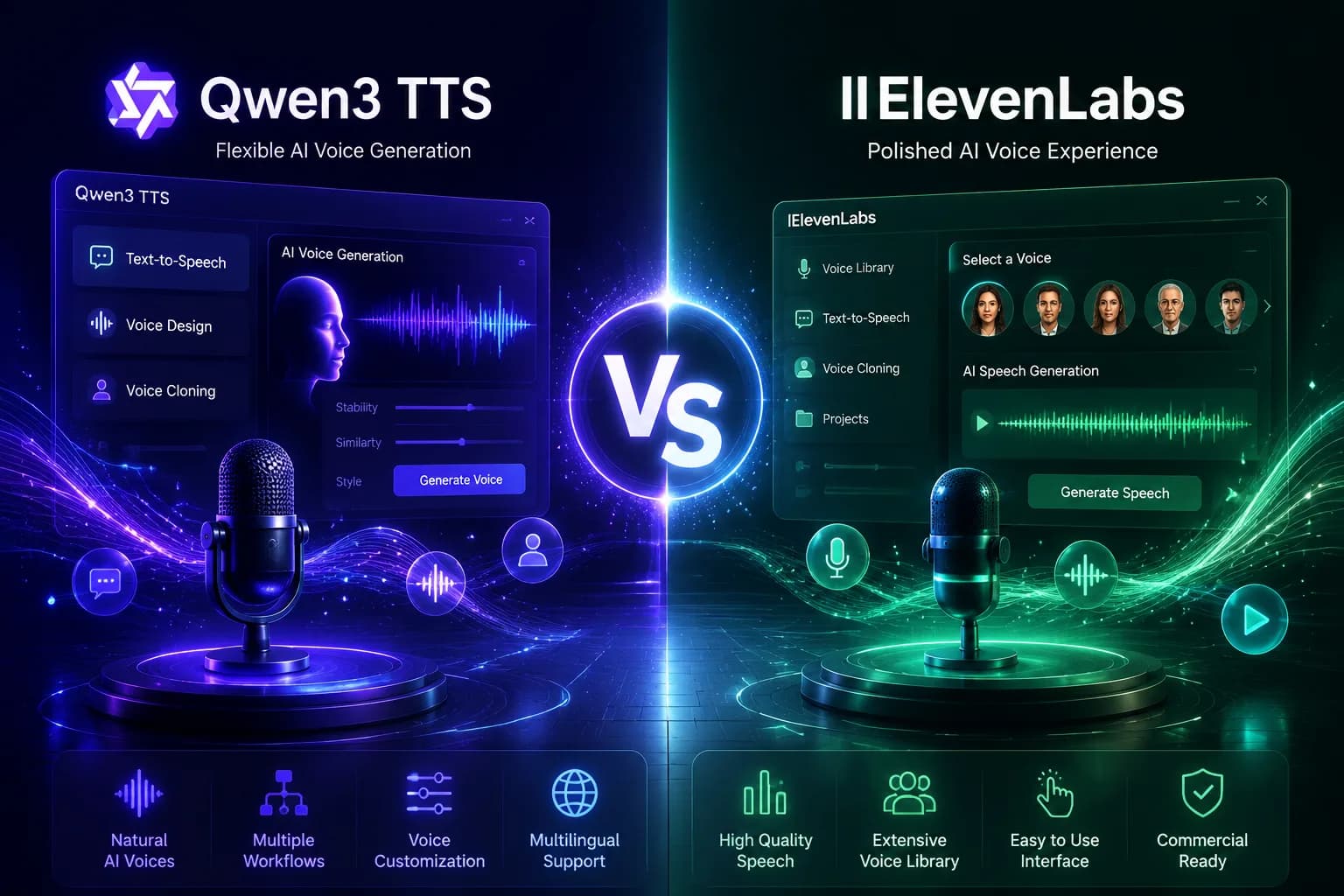
Start with the workflow, not a winner
Qwen3 TTS and ElevenLabs both provide text-to-speech and voice-related workflows, but the right choice depends on the model, control surface, language, voice rights, budget, and product requirements that apply when you evaluate them.
This is a documentation-based workflow comparison, not an independent benchmark. It does not assign quality scores, declare a universal winner, or treat the available product information as proof of a result in every language or configuration.
What this comparison covers
Use this page to frame a short, fair evaluation around:
- text-to-speech controls and voice selection
- voice creation, cloning, and authorization requirements
- style direction and prompt workflow
- target-language and pronunciation checks
- production constraints such as pricing, licensing, latency, and integration
Qwen3 TTS: documented model workflows
Official specification: The Qwen3-TTS repository describes separate model workflows for CustomVoice, VoiceDesign, and Base voice cloning. The documented capabilities and supported languages apply to those released models; they do not automatically describe every third-party implementation.
On qwen3tts.net, available controls are identified by the current interface. Check the selected mode and model before assuming a feature is available in the browser workflow.
Questions to test
- Can the selected workflow produce the delivery you need with a clear instruction?
- Does the available model match the target language and the voice type you need?
- For cloning, do you have explicit permission for the reference voice and a clean representative sample?
ElevenLabs: documented product workflows
Official specification: ElevenLabs documents text-to-speech, a voice library, voice design, and both instant and professional voice-cloning workflows. Availability, language coverage, model behavior, and plan limits depend on the current product and selected model.
Questions to test
- Which current model and voice option match the target language and delivery?
- Does the intended voice workflow meet your consent, rights, and storage requirements?
- Can the available settings reproduce the same result with your representative script?
A fair evaluation method
Use the same permitted source material and change one meaningful variable at a time. For each candidate, record the model, voice, language, script, instruction, date, and any relevant settings.
| Check | What to look for |
|---|---|
| Pronunciation | Names, acronyms, numbers, and domain-specific terms in your target language |
| Pacing | Sentence boundaries, pauses, and speed across short and long passages |
| Consistency | Whether repeated generations meet your workflow needs under the recorded settings |
| Style control | Whether documented controls produce a useful, repeatable change for the same script |
| Voice cloning | Permission, recording quality, reference requirements, and the limits of the resulting voice |
| Operations | Current pricing, usage limits, API or browser requirements, export format, and licensing |
Do not turn this checklist into a model-wide score. A result from one script, voice, or model is evidence for that configuration only.
Voice cloning and permissions
Only clone a voice when you have the necessary permission. Both platforms document voice-cloning workflows, but their current requirements, quality guidance, and plan availability differ. Read the applicable official documentation and terms before uploading reference audio or publishing generated speech.
Decision guide
Choose the workflow that proves suitable for your own representative material:
- Use Qwen3 TTS when its currently available model and controls fit the voice workflow you need.
- Use ElevenLabs when its current model, voice option, and terms fit the same requirement.
- Keep both in a short evaluation if the decision depends on a target language, a particular voice, or a regulated production use case.
Limits of this page
This article does not publish a shared test environment, source recordings, complete configuration logs, or independently repeatable output pairs for every claim that would be needed for a benchmark. It therefore makes no performance ranking, “winner,” or quality promise.
For a transparent description of the methodology used when qwen3tts.net publishes first-hand evidence, see How We Test. For the current site-specific audio evidence and its limitations, see the Qwen3 TTS Benchmark.
Method note
How We Tested
This guide is based on official model documentation and the current qwen3tts.net implementation. It does not represent an independent benchmark unless explicitly stated.
Read the full methodologySources & evidence
Primary sources for this comparison
- Qwen3-TTS official model repository
Official model documentation · QwenLM
- ElevenLabs Text to Speech documentation
Official product documentation · ElevenLabs
- ElevenLabs voice cloning documentation
Official product documentation · ElevenLabs
Try the workflow
Test Qwen3 TTS for Your Next Voice Project
Compare a short script in Qwen3 TTS, refine the delivery with an instruction, and decide whether its flexible workflow fits your production needs.
Try Qwen3 TTS